Add as the preferred source


 Universal Cart is one of the most significant innovations introduced by Google to transform eCommerce in the age of artificial intelligence. Its goal is to turn Google into a unified shopping hub capable of connecting users, merchants, and intelligent agents within a single shopping experience.
But first, let’s understand Google’s broader context: the internet giant is building a new infrastructure for eCommerce based on artificial intelligence, open protocols, and agents capable of executing actions throughout the purchasing process. Universal Cart, Universal Commerce Protocol (UCP), and AP2 are the core components of this new architecture, designed to connect users, merchants, and platforms through an interoperable model of agentic commerce.
What Is Universal Cart?
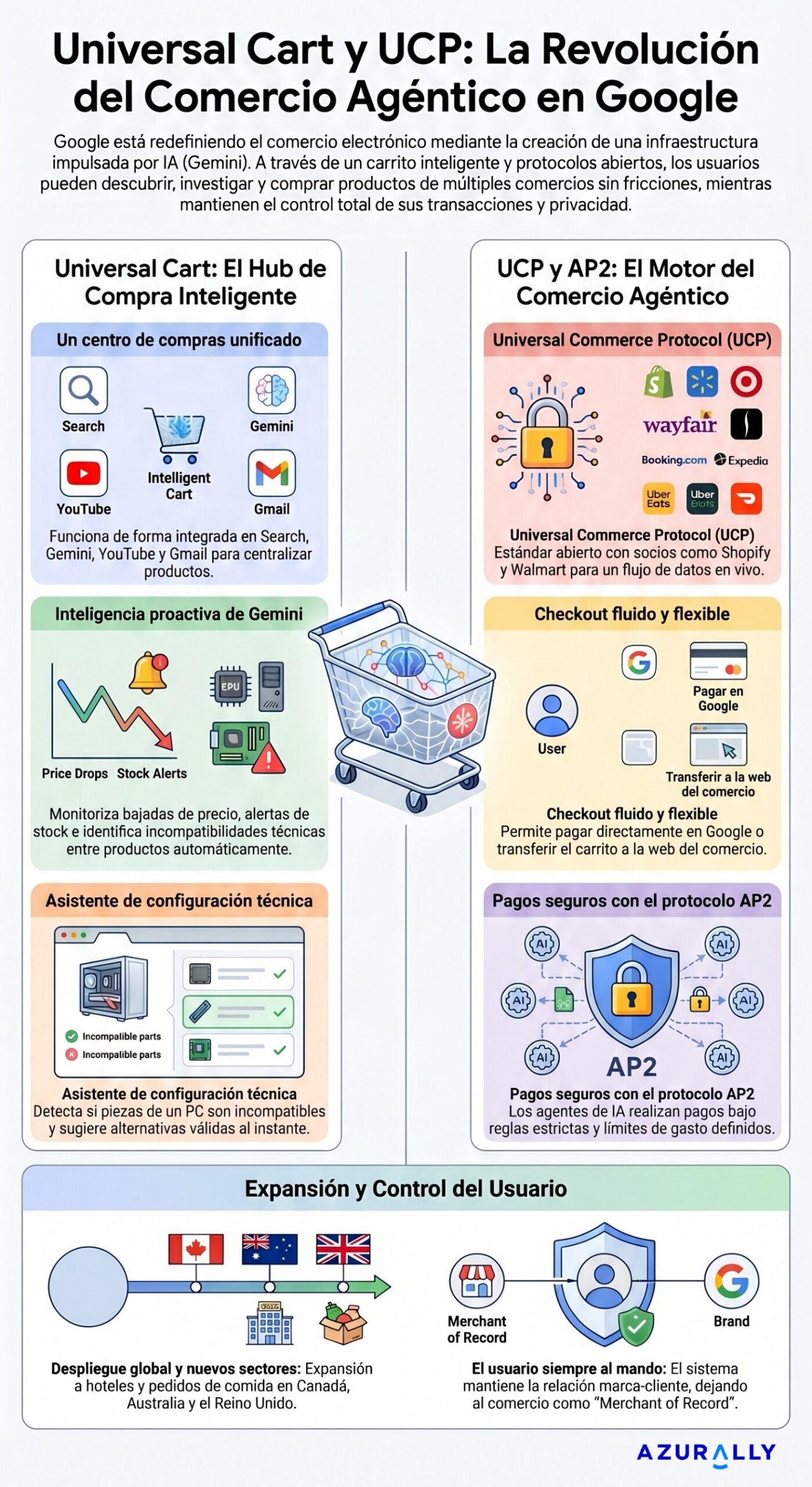
Universal Cart is Google’s new intelligent shopping cart designed to unify the shopping experience across multiple online stores. Unlike a traditional shopping cart, which is tied to a single eCommerce website, this solution enables users to manage products from different retailers directly within Google’s ecosystem.
It will integrate with Google Search, Gemini, YouTube, and Gmail, allowing users to start a purchase from any of these environments and continue it later without losing context. Universal Cart is no longer tied to a traditional online store but becomes part of Google’s ecosystem, ensuring that the shopping experience remains unified regardless of which merchant sells each product.
The integration of Gemini also adds reasoning capabilities throughout the entire customer journey. The system can monitor price changes, detect availability issues, compare different commercial offers, and even identify technical incompatibilities between products, automatically suggesting more suitable alternatives.
A New Architecture for eCommerce
Universal Cart is part of a much broader architecture in which each component plays a specific role within the purchasing process.
Gemini acts as the intelligent agent responsible for understanding the user’s needs, searching for information, and making assisted decisions. This intelligent shopping cart maintains the purchase state regardless of where the products are sold, while Google Pay and Google Wallet manage user identity, payment methods, and authentication throughout the transaction process.
Among these components is the Universal Commerce Protocol (UCP), the protocol responsible for connecting Google with different digital commerce platforms through an open standard for data exchange.
This separation between user experience, artificial intelligence, communication protocols, and payment systems makes it possible to build a much more flexible ecosystem than traditional eCommerce, where each platform operated independently. Each component has a specific role, but they all work together to create a seamless AI-powered shopping experience.
What Is Universal Commerce Protocol (UCP)?
Universal Commerce Protocol (UCP) is the open protocol Google is developing to facilitate the exchange of resources between online retailers, marketplaces, manufacturers, technology platforms, and intelligent agents.
Its purpose is to define a common structure for sharing commercial data without relying on platform-specific integrations. Thanks to this protocol, an AI agent can retrieve information about products, pricing, promotions, availability, variants, shipping methods, and product configurations directly from a merchant’s systems.
From a technical perspective, UCP defines a standardized model for exchanging information about products, inventory, pricing, promotions, availability, checkout, orders, and other commercial data between Google and eCommerce platforms. This model reduces the need to develop custom integrations for each retailer while enabling different AI agents to access the same information using a common protocol.
This approach is particularly relevant because it allows different platforms to speak the same language. Instead of building individual connections for every retailer, UCP establishes an interoperable model that simplifies communication across the entire digital commerce ecosystem.
Google has collaborated with companies such as Shopify and Walmart to develop this standard, which is expected to become the foundation for the next generation of AI-powered commerce.
AP2 and Secure Purchase Execution
One of the biggest challenges of agentic commerce is enabling intelligent agents to perform actions on behalf of users without compromising security.
To address this challenge, Google introduces AP2, a protocol designed to establish authorization rules during transactions. This system makes it possible to define spending limits, purchase conditions, validation mechanisms, and multiple authorization levels before an agent completes a transaction.
The goal is to allow artificial intelligence to act autonomously whenever authorized by the user while ensuring full control over executed operations and complete traceability of every action. This protocol is essential for AI agents to evolve from conversational assistants into agents capable of executing real commercial transactions within a secure environment.
Why Is Google Building This Infrastructure?
The evolution of Universal Cart, Universal Commerce Protocol (UCP), and AP2 reflects Google’s broader strategy to adapt eCommerce to the age of intelligent agents. The objective is not only to improve the shopping experience but also to create a common architecture that enables AI systems to discover, interpret, compare, and purchase products in a secure and standardized way.
In this new model, Google aims to become the interaction layer connecting users, merchants, and intelligent agents. Rather than having each retailer independently manage the entire purchasing journey, Google proposes an ecosystem based on open protocols where product discovery, comparison, configuration, payment, and cart management are performed seamlessly regardless of the originating platform.
This vision lays the foundation for what is known as Agentic Commerce, an environment where artificial intelligence agents act as intermediaries between consumers and merchants. For this model to succeed, structured commercial data, common communication protocols, and authorization mechanisms are essential so AI can perform actions on behalf of users while preserving security, privacy, and transactional control.
Google Merchant Center Takes on a New Role
The evolution of UC and UCP also changes the role of Google Merchant Center within Google’s ecosystem.
Until now, Merchant Center primarily served as the platform responsible for supplying product data to Google Shopping.
Merchant Center is no longer just a repository for Google Shopping in the U.S. It becomes one of the primary sources of structured product information used to surface products organically across Google. Product catalog quality, inventory freshness, pricing consistency, technical attributes, images, variants, and all other structured attributes become significantly more important because they will be consumed directly by intelligent agents during product discovery, comparison, and purchasing processes.
In this new scenario, Merchant Center evolves from a tool primarily focused on Google Shopping into a strategic component of the technological ecosystem supporting digital commerce and AI-powered agentic commerce.
Universal Cart and GEO: A New Way to Optimize Digital Commerce
The emergence of Universal Cart and Universal Commerce Protocol also changes how companies should approach visibility strategies within Google’s ecosystem.
Until now, most optimization efforts focused on acquiring traffic from traditional search engines. With the rise of intelligent agents, the priority shifts toward making commercial information easily understandable by AI systems.
In this context, GEO and Agentic GEO strategies evolve toward a model in which optimizing both content and structured data, product catalogs, and the information sources used by artificial intelligence to generate recommendations becomes essential.
A brand’s ability to appear throughout discovery and purchasing journeys will increasingly depend on the quality and structure of the data it provides to these new AI-driven systems.
GEO optimization is evolving into Agentic GEO, ensuring that AI systems such as Google and ChatGPT not only find products that can be sold but also actively recommend those products and brands.
Implications for Manufacturers, Retailers, and eCommerce Platforms
These technologies represent a major shift that directly affects manufacturers, retailers, marketplaces, and eCommerce platforms.
Companies will need to prepare their infrastructures so that artificial intelligence agents can access accurate, structured, and continuously updated product catalogs. This means improving catalog quality, keeping pricing and inventory synchronized, optimizing Google Merchant Center, enabling interoperability through open protocols, and ensuring that commercial information can be correctly interpreted by intelligent systems.
Beyond traditional search visibility, the new landscape requires businesses to prepare their platforms for a model in which artificial intelligence acts as the intermediary between brands and consumers.
Organizations that adapt their commercial infrastructure sooner will be better positioned to integrate into the new AI-driven product discovery and purchasing processes.
List of SEO publications
- Google updates: where Google is headed
- Google UCP and Universal Cart: Shopping Within Google
- How Google’s Evolution Is Changing the Rules of SEO and GEO
- From Traditional SEO to Agentic GEO: How Brands Should Prepare for Google’s New Era
- Del SEO al GEO y del GEO al OSO: Omnisearch Optimization (OSO)
- How Google will change in the near future
- Is your website ready to be GEO Friendly? This is how we have done it at Azurally
- User behavior on Google in the Pharmaceutical Sector
- The importance of the ALT attribute
- Voice searches and how to adapt your SEO to them
Featured SEO publications

Google Discover: Personalized Results Experience
Google, as a tech giant, continues to innovate — this time with Google Discover, a new feature designed to display personalized content to users. Unlike the traditional Google search engine where you enter a query, Google Discover proactively shows content it believes may interest you. But how does it know what information you care about?
Read article
User behavior on Google in the Pharmaceutical Sector
In a digital context saturated with information, and with an increasingly limited attention span, the user of search engines such as Google demands brief and structured information when making a query.
Read article
From Traditional SEO to Agentic GEO: How Brands Should Prepare for Google's New Era
The way users discover information is changing. For years, brands optimized their content to rank on Google through SEO strategies and, more recently, to ensure artificial intelligence models could understand, mention, and cite them through GEO strategies. Now, Google is evolving towards a new landscape where artificial intelligence not only answers questions but can also perform actions with the user’s permission.
Read articleContact SEO
Do you have a project or would you like more information? Feel free to send us a message using the form below.