Add as the preferred source


The way users discover information is changing. For years, brands optimized their content to rank on Google through SEO strategies and, more recently, to ensure artificial intelligence models could understand, mention, and cite them through GEO strategies. Now, Google is evolving towards a new landscape where artificial intelligence not only answers questions but can also perform actions with the user’s permission.
What is Agentic GEO?
GEO is the process of optimizing visibility within AI-powered search engines and large language models (LLMs). The goal is no longer just to generate clicks, but to ensure that LLMs and search platforms such as Google AI Mode, Google AI Overviews, Gemini, ChatGPT, and Claude understand a company’s information, use it as a trusted source, cite it, and recommend the brand within their responses.
This means optimizing not only content, but also the company’s digital infrastructure so that AI agents can understand information, access it securely, and interact with business systems whenever the user authorizes it.
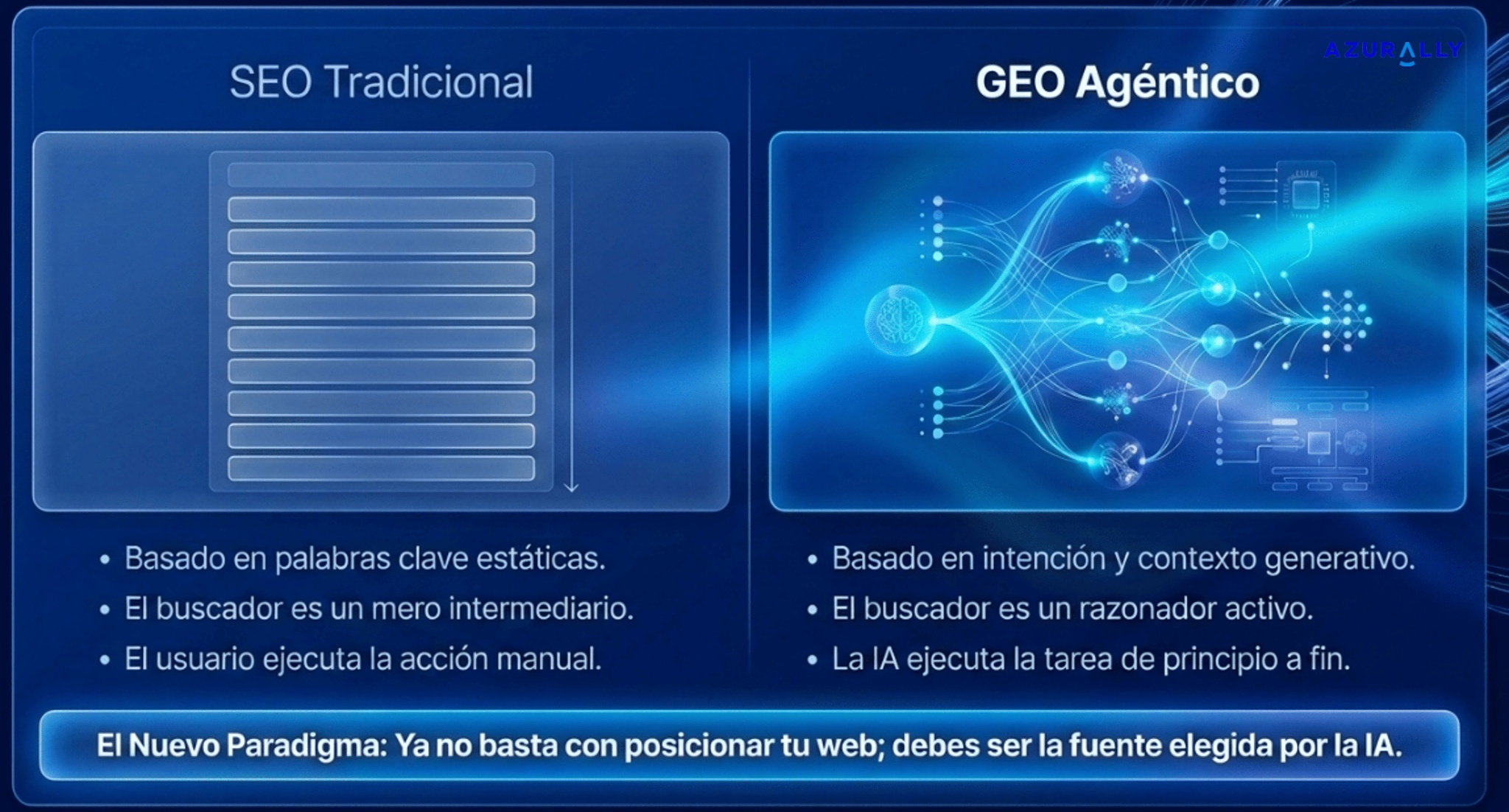
SEO vs. GEO vs. Agentic GEO
These three disciplines represent different stages in the evolution of search engines and artificial intelligence.
SEO (Search Engine Optimization)
SEO optimizes a website to rank in Google’s traditional search results. Its primary goal is to attract organic traffic through relevant content, website architecture, and keywords that match users’ search intent.
GEO (Generative Engine Optimization)
GEO focuses on visibility within AI-powered search engines and LLMs. The objective is no longer simply to generate clicks, but to ensure that models such as Gemini and ChatGPT understand the brand’s information, cite it, use it as a trusted source, and recommend both the content and the brand itself in their responses.
Agentic GEO
Agentic GEO goes one step further. It is designed for a future where AI-powered search engines, such as Google and ChatGPT, together with intelligent agents, can perform tasks directly, including completing purchases or booking reservations.
To make this possible, companies must prepare not only their content but also structured data, APIs, open protocols, and interoperable infrastructures that allow these agents to interact securely with their systems.
How Google Is Changing
Google is evolving from a traditional search engine into a platform where artificial intelligence accompanies users throughout the entire decision-making process.
With features such as AI Mode, search results are no longer just lists of links—they become conversations.
The next step is being shaped by initiatives such as Universal Cart and the Universal Commerce Protocol (UCP), pointing toward a future where Google and other AI systems will be able to discover products, compare alternatives, and even complete purchasing processes on behalf of users.
This evolution is built on the Universal Commerce Protocol (UCP), an open standard that will allow intelligent agents to interact directly with business platforms and transform AI conversations into actions such as reservations or purchases. Within this model, the company remains the Merchant of Record, retaining the commercial relationship with the customer as well as ownership of customer data.
New KPIs for a New Reality
As the way people discover and purchase products changes, so do the metrics we need to measure.
SEO
- Google rankings.
- Organic traffic.
- Click-through rate (CTR).
- Conversions.
GEO
- Visibility in AI-generated responses.
- Brand sentiment within AI responses.
- Average position in AI responses compared to competing brands.
- Brand mentions in AI responses.
- Citations in AI responses when the brand’s domain is used as a source.
- AI Share of Voice.
- Coverage across AI models such as Gemini, ChatGPT, Claude, and others.
Agentic GEO (A New Acquisition and Conversion Channel)
- Visits from Agentic Assistants and AI systems.
- A2A conversions: another AI agent interacts with the website to complete an action, such as a reservation or purchase.
- UCP conversions: purchases completed through AI agents using the Universal Commerce Protocol.
- A2C conversions: conversions achieved through interactions between AI agents and end users.
These metrics reflect the evolution of digital visibility—from measuring only traffic generation to evaluating a brand’s ability to be understood, recommended, and integrated into the new ecosystems powered by artificial intelligence.
The next transformation in digital visibility will not simply be about appearing in Google results or being cited by an AI model. It will be about preparing a company’s digital assets so that AI platforms such as Google AI Mode, ChatGPT, and Gemini, together with third-party intelligent agents, can understand its information, interact with its systems, and execute authorized actions on behalf of users.
List of SEO publications
- How Google’s Evolution Is Changing the Rules of SEO and GEO
- From Traditional SEO to Agentic GEO: How Brands Should Prepare for Google’s New Era
- Del SEO al GEO y del GEO al OSO: Omnisearch Optimization (OSO)
- How Google will change in the near future
- Is your website ready to be GEO Friendly? This is how we have done it at Azurally
- User behavior on Google in the Pharmaceutical Sector
- The importance of the ALT attribute
- Voice searches and how to adapt your SEO to them
- Keyword tracking: what is it and how is it done?
- How AI affects SEO strategies