Add as the preferred source


The latest updates introduced by Google are not simply a collection of independent new features. They are part of a much broader strategy that redefines the company’s role within the digital ecosystem.
Google is evolving from a search engine into an ecosystem where users can describe, compare, decide, and purchase the products they want. Information, conversions, and monetization now operate as a single integrated model. The goal is no longer just to answer questions or drive traffic, but to participate in every stage of the customer journey and capture an increasingly larger share of the value generated throughout that process.
Google: A Fully Integrated Ecosystem
The Full Stack concept describes an organization capable of controlling every technological layer required to deliver a complete AI-powered experience.
In Google’s case, this integration spans from physical infrastructure to the applications used by millions of people every day.
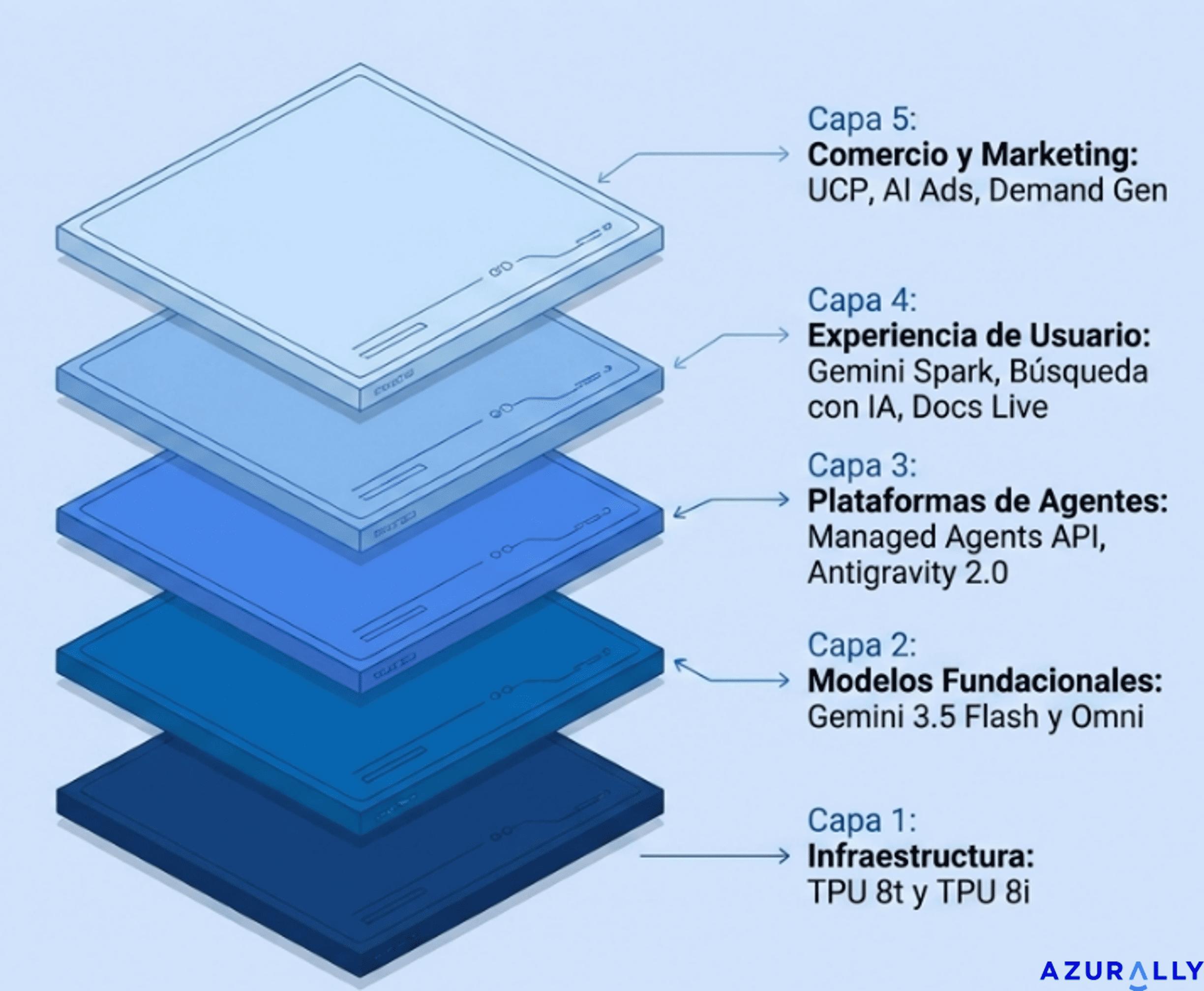
This architecture can be understood as five major interconnected layers:
- Infrastructure
At the foundation are Google’s data centers, global network, TPU chips, and Google Cloud. This infrastructure provides the computing power required to train and run artificial intelligence models at scale.
- Artificial Intelligence Models
Built on top of this infrastructure are models such as Gemini, responsible for multimodal reasoning, language understanding, content generation, and the decision-making capabilities that will power the next generation of digital experiences.
- Intelligent Agents
The next layer introduces agents capable of interpreting goals, planning tasks, and executing actions on behalf of users. These agents no longer simply answer questions—they become assistants capable of interacting with applications, services, and digital platforms.
- Products and Experiences
Google integrates these capabilities into products that are already part of millions of users’ daily lives, including Search, Gmail, Maps, Android, Chrome, Workspace, YouTube, and Google Shopping.
As a result, artificial intelligence is no longer a standalone tool but becomes seamlessly integrated across the entire Google ecosystem.
- Commerce and Monetization
The final layer connects all this intelligence to the business.
Solutions such as Universal Cart, Google Wallet, and the Universal Commerce Protocol enable artificial intelligence not only to provide information but also to participate in commercial processes such as comparing products, recommending options, and facilitating purchases directly within the Google ecosystem.
A New Operating Model
This Full Stack approach reflects a fundamental shift in Google’s operating model.
For years, Search served as the primary gateway to the digital ecosystem. Users performed a search, visited a website, and completed the rest of their experience there.
Artificial intelligence fundamentally changes that journey. Google can now accompany users throughout every stage of the process: understanding a need, providing recommendations, comparing alternatives, answering questions, supporting decisions, and connecting directly with services or platforms whenever necessary. Search is no longer simply an entry point—it becomes an intelligent platform capable of orchestrating the entire experience.
From Search Engine to Ecosystem
Google’s strategy represents a much broader transformation than simply introducing new features.
The company aims to integrate all its technological capabilities into a single connected ecosystem, where infrastructure, AI models, applications, and commerce share information and operate in a coordinated manner.
This integration improves the user experience, reduces friction between services, and accelerates the development of new AI-powered capabilities.
At the same time, it strengthens Google’s competitive position by controlling every technological layer required to deliver these services.
The New Revenue Model
The shift toward a Full Stack model also transforms the way Google generates revenue.
Traditionally, its business was closely tied to search volume and the advertising associated with it.
In the new landscape, the company aims to participate in many more moments throughout the customer journey.
Each new layer added to the ecosystem—infrastructure, artificial intelligence, agents, applications, or commerce—creates additional monetization opportunities.
This means Google is no longer focused solely on increasing search volume, but on maximizing the economic value generated throughout the entire user experience. In other words, the more services users consume within the Google ecosystem, the greater Google’s ability to generate revenue.
What Does This Change Mean for Businesses?
For organizations, this evolution represents a profound transformation.
Visibility will remain important, but it will no longer depend solely on search rankings. Businesses will need to prepare their digital assets to integrate into an ecosystem where artificial intelligence can access content, data, catalogs, services, and platforms much more directly.
This requires combining SEO strategies with GEO initiatives, strengthening the brand’s digital authority, improving data quality, and building an infrastructure capable of interacting with the new AI-powered systems.
Much More Than an Update
The innovations introduced by Google represent far more than the evolution of a search engine. They define a new technological architecture where infrastructure, artificial intelligence, products, and commerce operate as parts of a single operating model.
Understanding this strategy makes it possible to view all of Google’s recent innovations as components of the same objective: building an ecosystem capable of accompanying users throughout their entire digital journey while creating new business opportunities through artificial intelligence.
For businesses, understanding where Google is heading is no longer simply a technological matter. It is an essential step in adapting their visibility, marketing, and business strategies to the new digital landscape.
List of SEO publications
- Google updates: where Google is headed
- Google UCP and Universal Cart: Shopping Within Google
- How Google’s Evolution Is Changing the Rules of SEO and GEO
- From Traditional SEO to Agentic GEO: How Brands Should Prepare for Google’s New Era
- Del SEO al GEO y del GEO al OSO: Omnisearch Optimization (OSO)
- How Google will change in the near future
- Is your website ready to be GEO Friendly? This is how we have done it at Azurally
- User behavior on Google in the Pharmaceutical Sector
- The importance of the ALT attribute
- Voice searches and how to adapt your SEO to them