Add as the preferred source


The latest update unveiled by Google marks the beginning of a new era in digital search. Artificial intelligence is no longer just a complement to search—it has become the core of the search experience, transforming the way users find information and how brands must approach their online visibility.
Google is evolving from a search engine primarily based on links into an experience where artificial intelligence understands context, reasons over information, and assists users throughout the entire search journey. For businesses, this means adapting their SEO strategies and strengthening their presence across AI-powered search engines through a GEO strategy.
From Search Engine to Intelligent Assistant
For years, SEO had one clear objective: getting a webpage to rank among Google’s top search results. With the introduction of artificial intelligence, that objective has evolved. Ranking a website is no longer enough; brands must also become trusted sources for AI models capable of understanding their information, recognizing its relevance, citing it, and using it to generate responses.
Visibility is no longer determined solely by rankings—it increasingly depends on a brand’s ability to provide relevant, consistent, and trustworthy information.
Google Intelligent Search Box: Search Becomes Multimodal
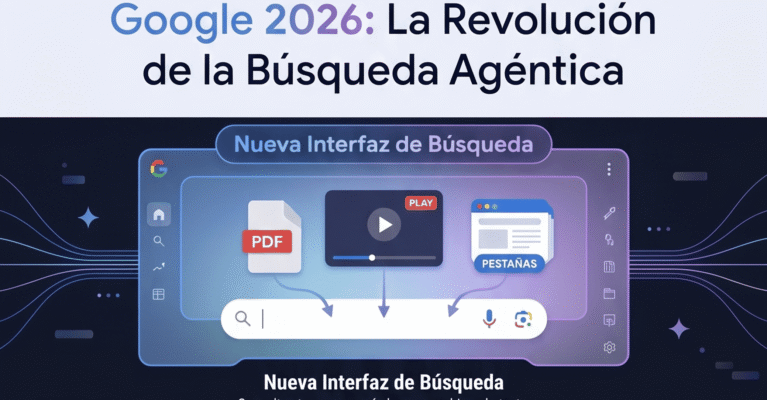
One of the most significant changes is the evolution of Google’s search box. Queries are no longer limited to text—they are becoming multimodal experiences. Users will be able to combine text, images, videos, PDF documents, and even information from open Chrome tabs to explain exactly what they need.
This will enable artificial intelligence to understand the context of each query much more accurately and deliver more precise answers.
For businesses, this represents a major shift: optimizing webpages alone will no longer be sufficient. Every content format published across a brand’s digital ecosystem will need to be optimized in a coordinated way.
Google Search Live: Search Happens in Real Time
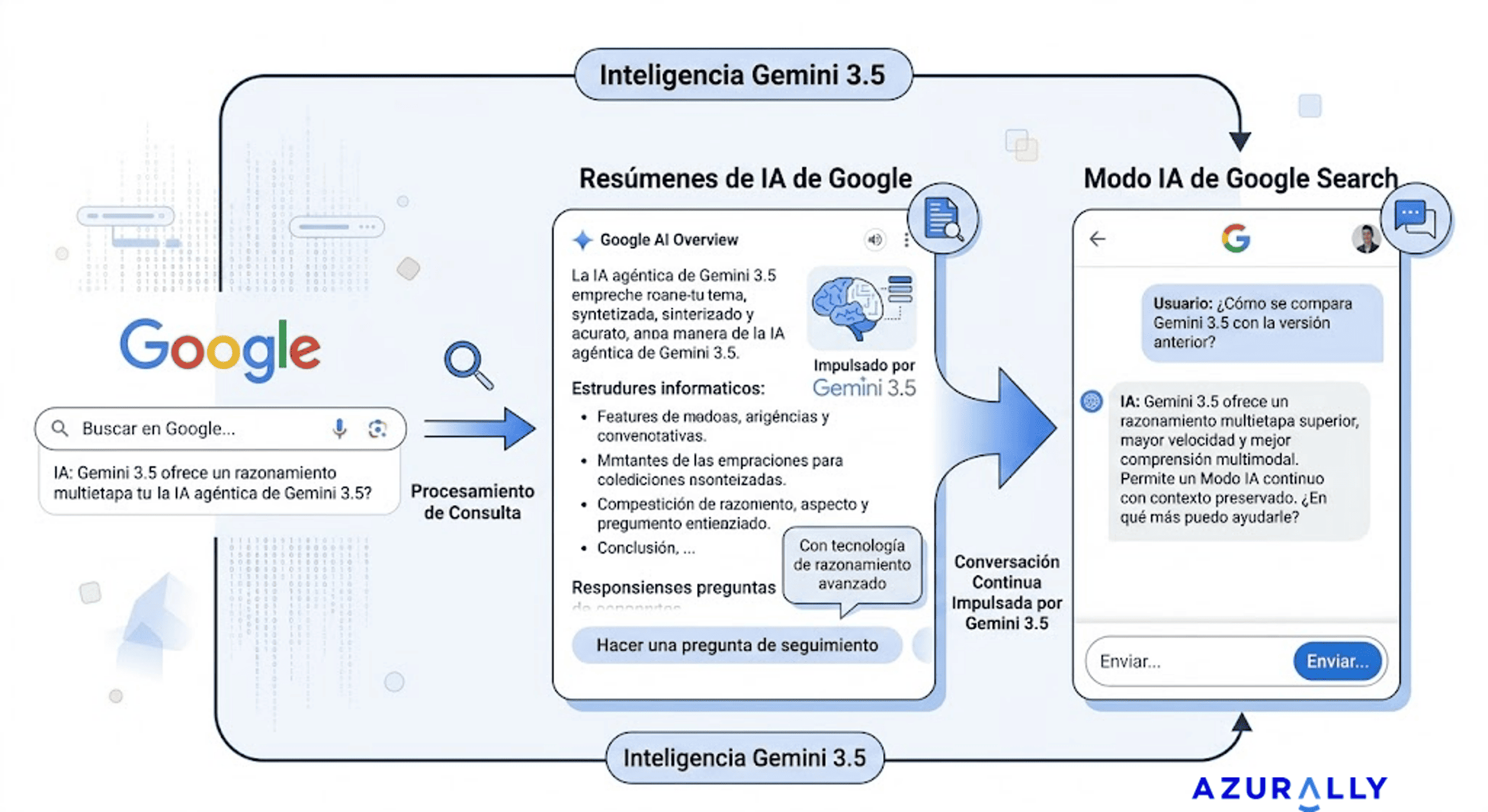
Google introduces a far more dynamic search experience, where interaction with artificial intelligence becomes continuous and contextual. Users no longer perform isolated searches but engage in an ongoing dialogue with the search engine, which continuously adapts its responses as the conversation evolves.
Google Seamless Search: The Boundary Between Searching and Conversing Disappears
Another major innovation is the move toward a much more fluid search experience. Queries are no longer independent—they become continuous conversations. AI remembers the context of previous questions, interprets user intent, and adjusts its responses as the conversation progresses.
Search is becoming increasingly similar to talking with an expert who fully understands the context of our needs.
This also changes the way content should be created. It is no longer enough to answer a single keyword; content must solve complex questions, connect related concepts, and address multiple user needs within the same conversation. As a result, traditional search traffic is likely to decline, reinforcing the importance of developing a GEO strategy.
Information Agents and Search Agents: AI Searches on Our Behalf
Google is introducing a new generation of intelligent agents capable of performing multiple searches simultaneously, consulting hundreds of sources, comparing information, identifying contradictions, and producing well-founded conclusions.
Rather than simply displaying links, these agents research on behalf of users and synthesize the most relevant knowledge. This represents a significant change for brands: if a company is not among the sources consulted by these agents, its visibility within AI-generated responses will be significantly reduced.
As a result, digital authority becomes just as important as traditional search rankings.
Agent Coding: Artificial Intelligence Also Builds Solutions
Another capability introduced by Google is the ability for artificial intelligence to generate small applications, automations, or technical solutions directly during user interactions.
This functionality opens new opportunities for technology companies, developers, and organizations that produce technical documentation, as AI will be able to interpret that knowledge and transform it into practical solutions.
Personal Intelligence: A Fully Personalized Search Experience
Search will also become much more personal. Google will combine information about the user’s context with data from different services across the Google ecosystem, always respecting user permissions and privacy controls.
The goal is to provide responses tailored to each specific situation by considering preferences, history, and pending tasks. Consequently, businesses will need to create content capable of serving different user profiles and multiple search contexts.
Preferred Sources and Highly Cited: Authority Becomes the New Competitive Advantage
One of the most impactful changes for brands is the increasing importance of source authority.
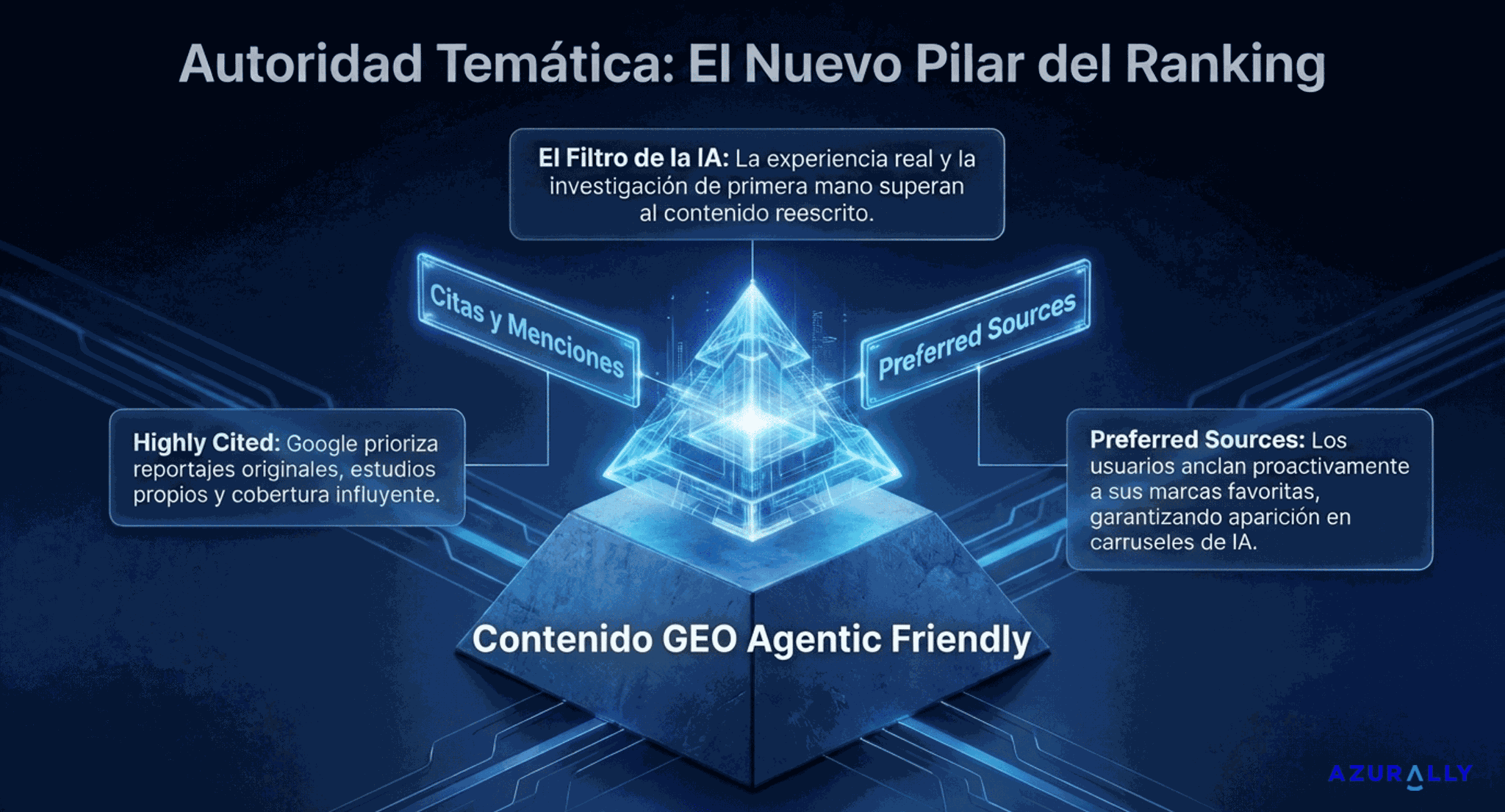
Google will give greater prominence to Preferred Sources—sources users consider trustworthy—and to Highly Cited content that receives references and mentions from other authoritative publications. This means that simply publishing more content than competitors will no longer be enough.
Businesses will need to build genuine digital authority. Public relations strategies, original research, media presence, and high-quality citations will play a much more significant role in any GEO strategy.
Topical Authority Becomes the New Foundation of Visibility
Google’s latest update highlights a fundamental shift: topical authority is becoming increasingly important within AI systems. Demonstrable expertise, original research, earned citations, preferred sources, and information consistency are becoming signals that help AI determine which content is genuinely trustworthy.
For brands, this means developing a coordinated strategy that combines content marketing, public relations, digital reputation, and the creation of specialized knowledge.
Google Begins Providing Greater Visibility Into AI Data
Another innovation is the integration of artificial intelligence-related information directly into Google’s search ecosystem. Google is moving toward a model where it not only generates answers but also provides greater transparency regarding the sources used and the confidence level associated with the information presented.
This requires businesses to pay particular attention to data quality, content authorship, source attribution, and consistency across all their digital assets.
SEO Is Evolving Into GEO
All these changes lead to one clear conclusion: SEO remains essential, but it is no longer sufficient on its own.
SEO continues to provide the foundation for organic visibility. GEO expands that strategy so information can also be understood, used, and recommended by AI search engines and LLMs.
The objective is no longer simply to attract traffic from Google but to become a trusted source for artificial intelligence engines. GEO combines traditional search optimization with optimization for generative experiences, digital authority building, public relations, online reputation, and a content strategy specifically designed to be understood, cited, and recommended by AI.
Preparing Today to Lead Tomorrow’s Search
Google’s latest update is redefining how people will discover information, products, and services over the coming years. Organizations that want to remain competitive will need to complement their SEO strategies with a GEO approach that integrates communication, content, digital authority, and technology.
At Azurally, we help businesses navigate this transformation by bringing all these disciplines together into a single strategy. Because the challenge is no longer simply appearing in search results—it is becoming one of the sources that artificial intelligence chooses, understands, and recommends.
Brands that begin building that authority today will be better prepared to compete in a future where AI becomes the primary intermediary between people and information.
List of SEO publications
- How Google’s Evolution Is Changing the Rules of SEO and GEO
- From Traditional SEO to Agentic GEO: How Brands Should Prepare for Google’s New Era
- Del SEO al GEO y del GEO al OSO: Omnisearch Optimization (OSO)
- How Google will change in the near future
- Is your website ready to be GEO Friendly? This is how we have done it at Azurally
- User behavior on Google in the Pharmaceutical Sector
- The importance of the ALT attribute
- Voice searches and how to adapt your SEO to them
- Keyword tracking: what is it and how is it done?
- How AI affects SEO strategies