Add as the preferred source


From AI Overviews to AI Mode without friction: the new paradigm that forces a rethink of digital strategy from the Generative Digital Footprint.
By Diego Jiménez, CEO of Azurally
On 3 December 2025, Google officially announced the implementation of Seamless Search. On 1 March 2026, we detected the first cases in LATAM (Colombia IP). If recent history serves as a reference, Europe will be next. And when it arrives, it will not be a simple interface adjustment. It will be a structural shift in how organic traffic is distributed (and destroyed).
Historically, Google’s rollout has followed a very clear pattern: first the United States, then LATAM (5–6 months later), and finally the European Union between 9 and 12 months afterwards. This means we are once again at a competitive disadvantage, learning late what other markets are already optimising.
If, in response to an informational search, AI Overviews already appear in 99% of cases, with an average traffic loss of around 30%, Google AI Mode could accelerate that drop to as much as 80%. With the arrival of Seamless Search, the scenario is clear: organic traffic reductions of up to half compared with the pre-AI era. This is not a hypothesis. It is a transition already under way.
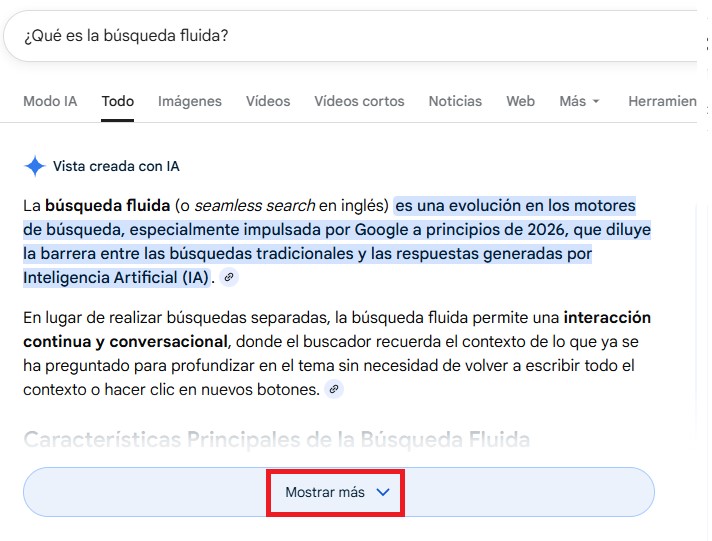
What exactly is Seamless Search?
It is not an isolated functionality. It is a conceptual redesign of the search experience. The boundary between the AI summary (AI Overviews) and the conversational mode (AI Mode) disappears. Users no longer “jump” between tabs. The experience flows. Its key characteristics:
- Continuous context: the search engine remembers previous queries and allows deeper exploration without restarting the context.
- Seamless transition: moving from the Overview to chat (AI Mode) happens naturally, without switching tabs.
- Powered by Gemini 3 (2026): improved accuracy, contextual capability and response quality.
- “Ask anything” format: a conversational model designed for deep research.
- Integration with Deep Search: the ability to generate cited reports after reviewing multiple sources.
Seamless Search is not simply a technical improvement; it is an evolution in the experience that transforms the way we interact with information, because it removes friction between devices and allows a search to begin on mobile, continue on a computer, or even from the car without losing the thread of the conversation.
In essence, Seamless Search is a search experience that flows with you: multimodal because it integrates text, voice and image; conversational because it maintains the thread; contextual because it understands the environment; actionable because it enables actions to be executed; and integrated because it connects products and experiences within the same ecosystem. A true all-in-one solution.
What does Seamless Search really imply: is the sector prepared to keep losing traffic?
It is not a simple feature; it is a philosophy of experience designed so that users do not have to leave the ecosystem. And this is the truly critical point: you no longer need to click on a URL.
The change is already visible in LATAM because, whereas until now in Spain when you perform a query and an AI Overview appears the user remains within the expanded summary block, in LATAM (as already happens in the United States) the transition to Google AI Mode occurs seamlessly directly from that summary. It may seem like a small product gesture, almost imperceptible at the interface level, but strategically it is enormous because it removes the final microsecond of decision before clicking on an organic result.
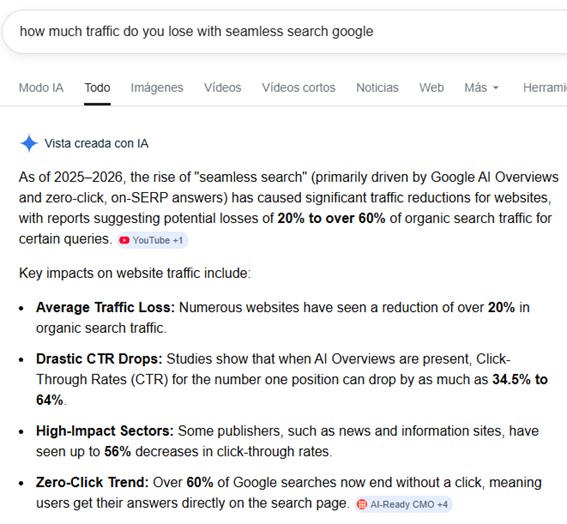
And this is where the relevant question arises: is the sector prepared for this? In my opinion, it is not. This reality has been evident since March 2025 and, a year later, the developments only confirm that the decline in natural traffic is not stabilising but accelerating. The question I constantly receive is whether it still makes sense to invest in corporate websites and e-commerce, and my answer is clear: yes, now more than ever, but not with the 2019 mindset.
The reason is simple: the website is no longer only a direct acquisition channel; it is the structural heart of digital coherence. If the messages on the website, on social media, in PR, offline and at physical touchpoints are not aligned, AI will project inconsistencies.
What is the main effect of this? When AI projects inconsistencies, reputation becomes fragmented. In this new environment we are no longer optimising only for Google; we are optimising for the way AIs interpret, synthesise and redistribute our brand. This requires strategic coherence, a solid content architecture and a cross-functional vision of the Generative Digital Footprint, because Seamless Search is not the end of traffic; it is the end of traffic as we knew it. And the sooner we accept that change, the sooner we will be able to capitalise on it.
List of SEO Publications
- Google updates: where Google is headed
- Google UCP and Universal Cart: Shopping Within Google
- How Google’s Evolution Is Changing the Rules of SEO and GEO
- From Traditional SEO to Agentic GEO: How Brands Should Prepare for Google’s New Era
- Seamless Search is here: we are going to lose more traffic than we imagine
- Del SEO al GEO y del GEO al OSO: Omnisearch Optimization (OSO)
- How Google will change in the near future
- Is your website ready to be GEO Friendly? This is how we have done it at Azurally
- User behavior on Google in the Pharmaceutical Sector
- SEO Publications
Featured SEO publications
Google Discover: Personalized Results Experience
Google, as a tech giant, continues to innovate — this time with Google Discover, a new feature designed to display personalized content to users. Unlike the traditional Google search engine where you enter a query, Google Discover proactively shows content it believes may interest you. But how does it know what information you care about?
Read article
User behavior on Google in the Pharmaceutical Sector
In a digital context saturated with information, and with an increasingly limited attention span, the user of search engines such as Google demands brief and structured information when making a query. It is for this reason that Google, as a technological giant, adapts its interface by means of various functionalities various functionalitiesThis way, we can offer information adjusted to the query made.
Read article
The Post-Backlinks Era: Reddit, Conversational Authority, and the Future of SEO in 2025
In today’s digital ecosystem, we are witnessing one of the most profound shifts in the history of SEO and digital marketing. The integration of Google’s AI Overviews and other generative features is not merely an algorithm update — it’s a digital transformation in how users discover and consume information. At Azurally, we’ve identified that this marks the beginning of a new era, where Reddit and other community platforms become central to any advanced SEO strategy.
Read articleContact SEO
Do you have a project or would you like more information? Feel free to send us a message using the form below.