Add as the preferred source


For years, a brand’s Digital Footprint was defined by its presence in traditional search engines, social networks, marketplaces, and digital media. However, the rise of artificial intelligence has transformed this landscape: now it is key to be present across the AI ecosystem and intelligent assistants, as well as their evolution toward Omnisearch.
From SEO to GEO and from GEO to OSO
At Azurally, we have been studying this natural evolution for 3 years: from SEO to GEO, and as we start 2025, we are working on the natural evolution from GEO to OSO (Omnisearch Optimization), reflecting how digital strategies adapt to new user search and discovery behaviors. This gives rise to the Generative Digital Footprint (GDF), understood as the trace a brand leaves in generative search engines and AI models. 
Example of how an OSO strategy pivots strategically based on our expertise
The major paradigm shift we are discussing these days—and which will shape digital strategies—is called OSO (Omnisearch Optimization). We are no longer talking about optimizing in isolation for search engines, social media, or paid channels, but rather about a GEO + AIO strategy capable of impacting any channel and any format.
Pillars of Omnisearch
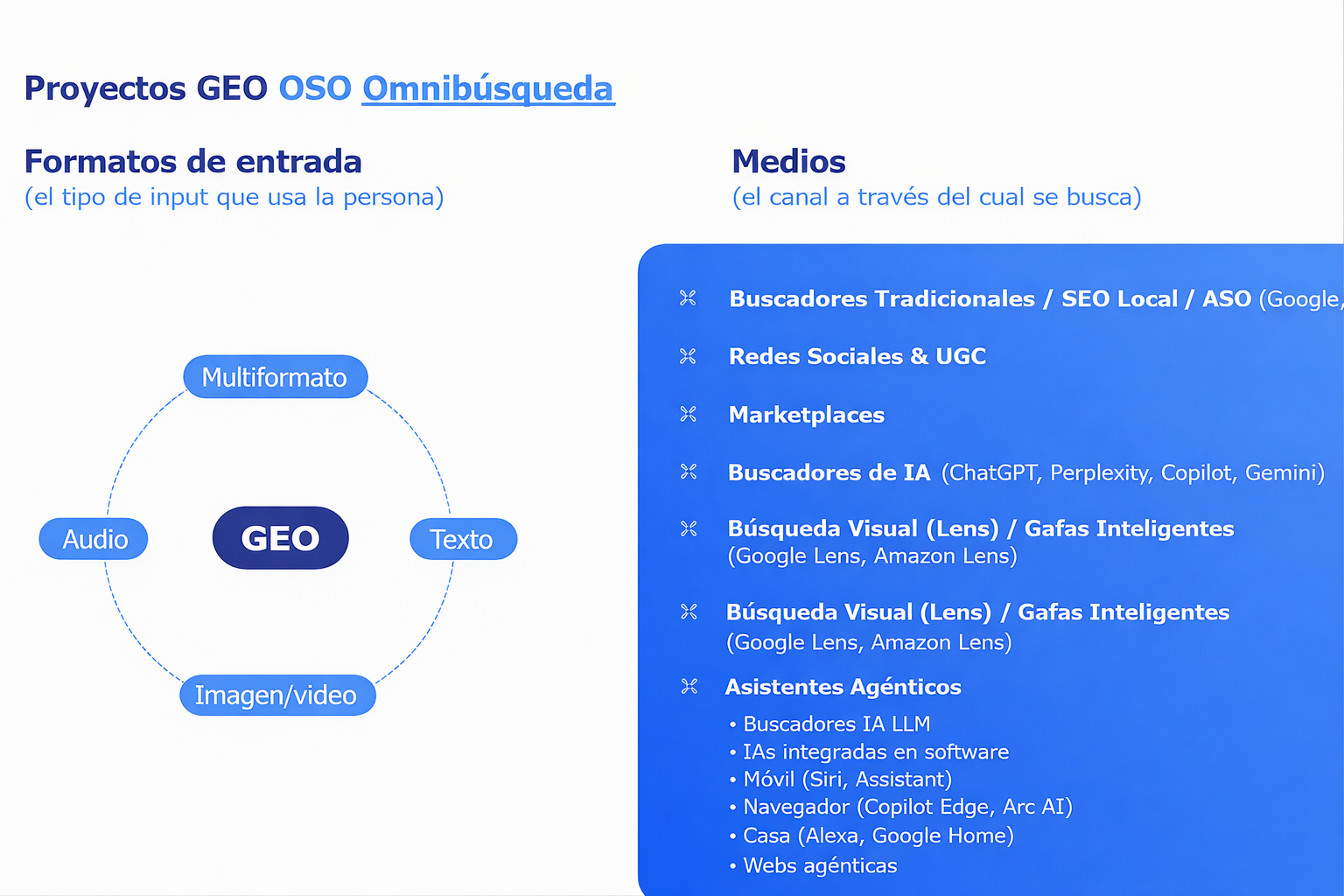
- GEO projects: generative SEO, GEO PR, GEO SM, paid, or agentic websites.
- GEO formats: content in text, image, audio, and video, adapted to the input chosen by the user.
- GEO media: this includes the entire search ecosystem—from traditional search engines (Google, Bing, Yahoo) to social networks and UGC platforms such as TikTok, Instagram, or YouTube, as well as marketplaces.
- AI search engines (ChatGPT, Perplexity, Copilot, Gemini)
- Visual search (Google Lens, Amazon Lens)
- Agentic assistants in all their variants: mobile (Siri, Assistant), browsers (Copilot Edge, Arc AI, Comet, Atlas, etc.), smart speakers (Alexa, Google Home), or AI-based websites.
All of this is integrated into a single Omnisearch approach, where users can begin their journey on Google, continue with a visual Lens search, and end by validating information with an AI assistant.
The new concepts shaping the direction
Within this ecosystem, three concepts consolidate the strategy:
- AIO (AI Optimization): optimization for any type of AI, ensuring presence in generative models, search engines, and conversational agents.
- OSO (Omnisearch Optimization): universal optimization for multimodal searches, bringing together SEO, AI, social, marketplaces, and more into a single strategic map.
- GDF (Generative Digital Footprint): the tangible result—the trace a brand projects across search engines and AI models, defining its visibility in the age of artificial intelligence.
In short, the transition from SEO to GEO, and from GEO to OSO, marks the move toward a scenario where the Generative Digital Footprint becomes the true reputational and competitive asset for brands.
At Azurally, we are already working under this new Omnisearch paradigm, integrating GEO + AIO strategies that optimize brand presence across the entire search ecosystem—from traditional engines to generative environments and AI assistants. Our approach combines technology, data, and content to ensure that every interaction with a brand—regardless of format or channel—reinforces its visibility, relevance, and consistency in the age of AI.
List of SEO publications
- Google updates: where Google is headed
- Google UCP and Universal Cart: Shopping Within Google
- How Google’s Evolution Is Changing the Rules of SEO and GEO
- From Traditional SEO to Agentic GEO: How Brands Should Prepare for Google’s New Era
- Del SEO al GEO y del GEO al OSO: Omnisearch Optimization (OSO)
- How Google will change in the near future
- Is your website ready to be GEO Friendly? This is how we have done it at Azurally
- User behavior on Google in the Pharmaceutical Sector
- The importance of the ALT attribute
- Voice searches and how to adapt your SEO to them
Featured SEO publications
Google Discover: Personalized Results Experience
Google, as a tech giant, continues to innovate — this time with Google Discover, a new feature designed to display personalized content to users. Unlike the traditional Google search engine where you enter a query, Google Discover proactively shows content it believes may interest you. But how does it know what information you care about?
Read article
User behavior on Google in the Pharmaceutical Sector
In a digital context saturated with information, and with an increasingly limited attention span, the user of search engines such as Google demands brief and structured information when making a query. It is for this reason that Google, as a technological giant, adapts its interface by means of various functionalities various functionalitiesThis way, we can offer information adjusted to the query made.
Read article
The Post-Backlinks Era: Reddit, Conversational Authority, and the Future of SEO in 2025
In today’s digital ecosystem, we are witnessing one of the most profound shifts in the history of SEO and digital marketing. The integration of Google’s AI Overviews and other generative features is not merely an algorithm update — it’s a digital transformation in how users discover and consume information. At Azurally, we’ve identified that this marks the beginning of a new era, where Reddit and other community platforms become central to any advanced SEO strategy.
Read articleContact SEO
Do you have a project or would you like more information? Feel free to send us a message using the form below.